
Your AI writes code.Now get an AI thatships product.
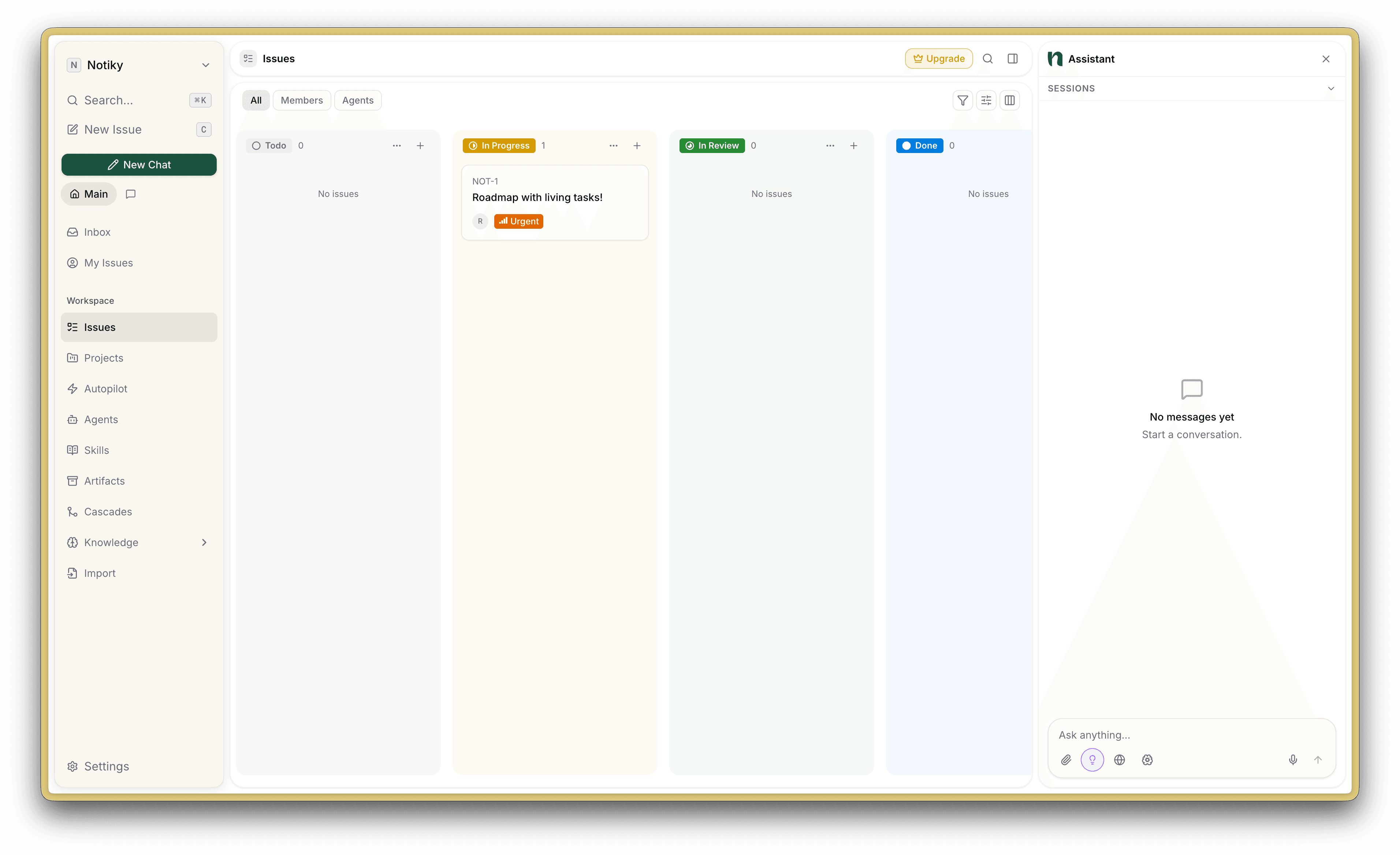
Notiky is the product brain for small teams building with AI. Every decision captured. Every agent in context. Every reason your roadmap looks the way it does — alive and searchable.
Free to start · no credit card required


The problem
Product context dies faster than code.
Decisions made in Slack. Feature specs in Notion. Customer feedback in Otter. Roadmap in Linear. Every coding agent starting cold. Three weeks later, nobody remembers why you chose this stack, why that feature got cut, or what the pivot actually meant.
Where decisions go today
- Slack threads — searchable for 90 days, then gone
- Notion docs — stale the day they're pinned
- Linear tickets — say what, never why
- Founder's head — one quit away from amnesia
- Agent context windows — cleared every run
What Notiky captures
- Every decision — the what, the why, the alternatives
- Every hypothesis — evidence, status, follow-ups
- Customer signals — linked to the decisions they shaped
- Roadmap drift — surfaced the moment it happens
- Context packs — piped to every agent, always fresh
Architecture
One engine for the whole product loop.
Every signal from your customers, your team, and your code flows through the same engine — reasoned in conversations, captured as decisions, composed into context packs, and executed by agents.
- Conversation pipeline
- Personas
- Quality gates
- Decisions
- Hypotheses
- Insights
- Artifact system
- Reference composition
- Drift checks
- Contradiction detection
- Overnight consolidation
- Harness catalog (5 backends)
- Local runner
- Autopilots
- MCP server
- Plugin runtime
Inputs
- Customer calls
- Meeting transcripts
- Code repos
- Linear / Slack signals
- Manual conversation threads
- Conversation pipeline
- Personas
- Quality gates
- Decisions
- Hypotheses
- Insights
- Artifact system
- Reference composition
- Drift checks
- Contradiction detection
- Overnight consolidation
- Harness catalog (5 backends)
- Local runner
- Autopilots
- MCP server
- Plugin runtime
Outputs
- Approved decisions
- CLAUDE.md, .cursor/rules
- SKILL.md, AGENTS.md
- Ship plans
- Live MCP context
How Notiky works
One loop.From signal to shipped.
Every feature, every agent run, every context pack — traceable back to the decision it came from.
Capabilities
Everything your product needs.In one workspace.
Your product brain
Every decision, insight, and signal — structured and searchable.
Think
Always in sync
Decision conflicts, context syncs, hypothesis updates — in real time.
Notiky is the product brain for small teams shipping with AI.
Project context, architecture decisions, coding standards — auto-generated.
Structured decisions with provenance: what was decided, why, and what was rejected.
Coding patterns, naming conventions, design tokens — synced across all repos.
Step-by-step execution plan with tasks, dependencies, and full reasoning.
Auto-versioned
Every document version tracked. Nothing lost.





Connects your tools
Your product context flows to every AI coding tool automatically.
Context packs
CLAUDE.md, .cursorrules, and decisions — ready to export.
The AI that argues back, not agrees.
Conversations are operator sessions, not generic chat. Ask, Think, Plan, and Do modes challenge assumptions from different angles — customers, tech, pricing, risk — with depth tracked as you go. When you’re ready, you get a draft decision, not a transcript.
Should we go mobile-first before Series A?
Red-team across 6 angles before the board call. Sub-agents pull evidence from the workspace and push back on each other.
7 of 8 interviews signal mobile-first. Teachers open the app on their phone, not the laptop. One caveat: power users still edit on web.
Linear and Height were both web-first pre-A. Height shipped iOS after the raise. Doesn't force our hand — it frees it.
Extracting the shared UI package is 4–6 weeks. Not a pre-A blocker. Web keeps shipping while mobile ramps.
Counter-note — 3 of the 8 were on-site interviews. Worth checking whether the signal holds in the full cohort before we call it.
Sub-agents that challenge, not nod
Each angle — customers, competition, tech, pricing, risk, timing — has its own sub-agent pushing back with evidence it pulled from your workspace.
Coverage you can actually measure
See which angles are covered and which aren’t. A Think session isn’t done because the room ran out of time. It’s done when the board is green.
Ends as a structured decision
Close the thread and Notiky hands you a draft decision with the rationale, the evidence, and the rejected alternatives already linked.
Every “why” behind every “what”.
Decisions are first-class objects with provenance. Each one links the hypotheses that fed it, the evidence that shaped it, the alternatives you rejected, and the decisions it supersedes. Three months later you can re-read the call, not guess at it.
Ship 3-tier pricing with 14-day trial
Basic added friction to the first touch without lifting ARPU. Collapse it into Free, keep Plus as the paid anchor, add Ultra for team scale. A 14-day trial on Plus replaces the old $14.99 entry point.
- Free tier lifts conversionValidated · +38% free→paid in 11-person cohort
- Ultra needed above 5 seatsValidated · 4 of 5 teams asked about seat-based pricing
- Basic plan friction at first touchSynthesized from 11 signups · Insight #214
- Keep the $14.99 entry pointRejected — dampens top of funnel without lifting ARPU
- Drop Basic planDecided 11 Apr 2026 · Rolled into Free + Plus
The “why” is a first-class object
Decisions link to the hypotheses, insights, and rejected alternatives that shaped them. Re-open one and the full context is already there — no archaeology required.
Supersession trail, not lost context
Reversing a call doesn’t delete the old decision. It supersedes it, with a pointer to what replaced it and why. The trail is the audit.
Roadmap drift surfaces itself
A hypothesis that hasn’t been validated in 30 days flags its linked decision. You notice the drift before a customer does.
Humans and agents, same thread, same decisions.
Agents don’t get a side channel. They read the decision, leave comments, link PRs, and answer reviews in the same place members do. Assignment is scoped to the decision they’re executing — so the “why” arrives before the “what”.
Refactor API error handling middleware
Scoped from Decision — Unified error envelope
Standardized responses across 14 handlers. PR #43 is up for review.
Same thread, not a separate tool
Agents comment, link decisions, and answer reviews where members already work. No agent DM channel, no second dashboard to check.
Assigned to decisions, not tickets
Work is scoped to the decision it’s executing. Agents read the “why” before they write the “what” — that’s how the output stays on intent.
One activity stream
Humans and agents interleave in the timeline. You see the full story — decisions, code, reviews, follow-ups — as it happens, in order.
Agents ship with product context, not prompts.
Every run opens with a context pack: CLAUDE.md, the linked decisions, the skills your team has built. Agents don’t arrive at a blank prompt — they arrive with memory. Blockers surface early; runs are replayable.
CLAUDE.md
Project guide · auto-attached
Decision — Unified error envelope
the why
Decision — Keep HTTP status codes
the guardrail
Skill — write-migration
available · unused
claude-ship-1
Ship error-handling PR from linked decision
Context pack, not prompt
Every run ships with CLAUDE.md, the linked decisions, and the skills your team has built. Agents arrive with product memory, not a blank slate.
Blockers surface early, not in post-mortem
Agents raise blockers against shared code before they edit it. You catch scope creep at minute two instead of hour two.
Runs you can replay
Every tool call, every file touched, every decision referenced — stored. Debug a bad run by reading it, not guessing at it.
Pricing
Start free. Scale when agents do.
One personal workspace and 500 agent credits, free forever. Upgrade when your agents start shipping real work.
Basic
One workspace, the whole planning loop.
Billed monthly
- 1 workspace
- 1,500 agent credits / month
- CLI + Desktop app
- 1 agent at a time
Pro
For solo founders shipping with agents.
Billed monthly
- Unlimited workspaces
- 6,000 agent credits / month
- 4× Basic volume at a better rate
- 3 agents in parallel
- Standard models
Ultra
For power users running agents all day.
Billed monthly
- Everything in Pro
- 37,500 agent credits / month
- 25% more credits per dollar than Pro
- 10 agents in parallel
- Premium models + deep research
Prices in USD. Cancel anytime. Annual plans billed as a single payment. Need more volume? Contact us for Scale.
FAQ
Questions & answers.
Notiky is the AI product brain — the workspace where every decision, hypothesis, customer signal, and product constraint becomes live context for Cursor, Claude Code, and your team.
Linear and Jira track execution. Notiky is the product brain above them: it records why decisions happened, what evidence shaped them, which hypotheses they validate, and what context agents need before they write code.
Cursor made coding context-aware. Notiky does the same for product management by giving founders, PMs, and AI agents the product memory behind every roadmap call, PRD, artifact, and agent task.
Claude Code, Codex, Cursor, Gemini CLI, Copilot CLI, OpenClaw, OpenCode, and more. The local runner auto-detects whatever you have installed.
Yes — the Notiky CLI. Run notiky setup to authenticate and connect MCP. Optional notiky serve starts the local runner, which auto-detects your installed harness CLIs and connects your machine to the workspace.
Agents run on your machine via the local runner, or on your own cloud machine. Code never passes through Notiky servers — the platform coordinates state and broadcasts events, that’s it.
As many as your hardware supports. Each agent has configurable concurrency, and you can connect multiple machines as local runners.
Ship fromnot vibes.
Open signup · no credit card required